
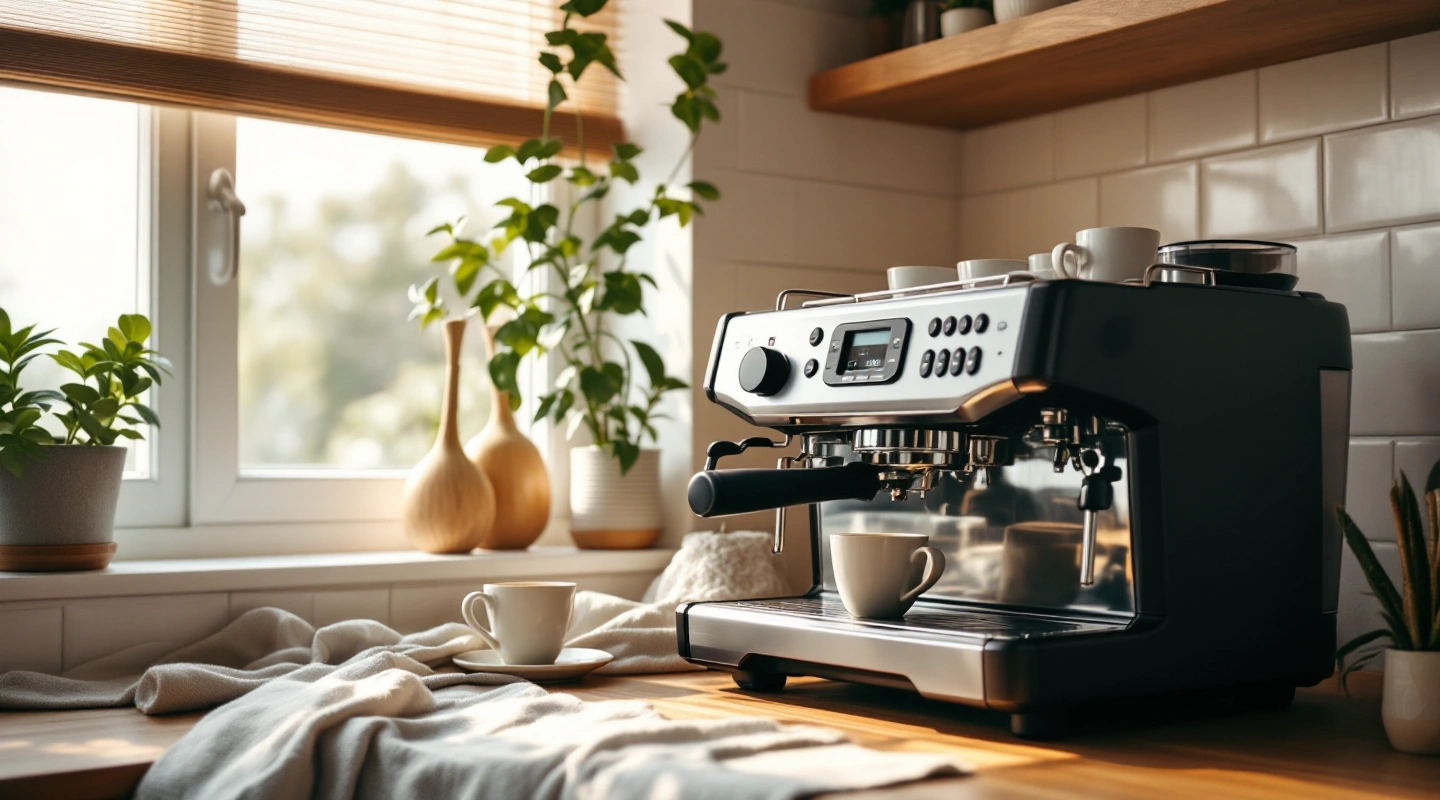
The automatic vs semi automatic espresso machine choice turns on which job the machine takes over. An automatic shot stop can end the water flow while you still grind and tamp. A fully automatic bean-to-cup system also handles coffee inside the case. Check that distinction before comparing convenience.
Choose a semi-automatic workflow if you want to prepare the basket and adjust recipes. Choose an automatic shot stop if you want help ending a repeatable shot. Choose bean-to-cup only after checking its settings and cleaning tasks. Automatic milk is a separate feature. Neither label proves better taste, and neither establishes an under-budget price.
Automatic vs semi automatic espresso machine: define the controls
An automatic machine is not always a bean-to-cup machine. Some sellers use automatic for a portafilter model with saved shot volumes. You still prepare the coffee in the basket. The machine ends the water flow after the programmed amount.
A semi-automatic pump machine normally puts more of that shot control with the user. Some models offer both saved volumes and a manual mode. The categories overlap in shop language. Write down the actual steps instead of treating the title as a complete specification.
The National Coffee Association's espresso guide separates four levels of user control. Its labels are a useful starting point. Exact product manuals settle the controls on a particular model.
Compare the coffee stop and the milk controls
Start with the tasks you want the machine to perform. The BES450 US manual, Functions, describes both programmed cup volumes and manual shot control. It shows why a portafilter machine can offer automatic stopping without taking over basket preparation.
The Gaggia Classic Pro US manual documents its brew and steam workflow. Compare that sequence with the controls you want to use each morning. A saved coffee volume does not settle milk handling, cleanup or how much loose-coffee preparation remains.
Automatic vs semi automatic espresso machine task table
| Task | Semi-automatic portafilter workflow | Automatic stop on a portafilter machine | Fully automatic bean-to-cup |
|---|---|---|---|
| Grind coffee | User or separate grinder | User or grinder provided by model | Internal grinder in the usual bean-to-cup design |
| Prepare basket | User | User | Internal brew process |
| Start shot | User control | User control or drink setting | Drink setting |
| End shot | User stop or model-specific option | Saved amount | Programmed cycle |
| Steam milk | Depends on the model | Depends on the model | Depends on the milk system |
| Clear waste | Remove puck and rinse parts | Remove puck and rinse parts | Empty waste container; follow brew-unit care |
Scroll for more →
This table describes workflows. It is not an exact feature list for every machine sold under each label. A hybrid model may cross columns. Use the manual to mark the actual task owner before you compare two candidates.
What an automatic shot stop changes
It takes one control action out of the normal shot. Once set, the machine can stop the programmed cycle for you. That can help a household repeat a routine without watching for the end in quite the same way.
It does not make an uneven puck even. It does not prove the grind is right. Using different beans can alter the drink even when the programmed water amount stays the same. Dose and grind adjustments can do that too.
Check how you set and cancel the volume. Find out whether the machine keeps the setting after power-off. Read how to stop a shot early. These steps show what the button does. The word automatic alone cannot tell you that.
A cup button is not a dose control for a basket you fill by hand. If you put less coffee in that basket, pressing the same button does not restore the missing grounds. Record the dry dose separately from the saved water amount. This keeps a shot-stop feature from being mistaken for automatic strength control.
What bean-to-cup changes
Bean-to-cup moves grinding and dosing into the machine. You handle fewer loose grounds for each drink. Check the recipe settings for the exact system. Read what its strength control changes. Look at the drink-volume limits too, rather than assuming total freedom.
You still supply beans and water and remove waste. Internal coffee paths need the maker's cleaning process. A waste drawer is easier to see than a brew unit, but neither should be ignored because the display offers a rinse button.
If more than one person uses the machine, check whether settings are easy to repeat. A saved drink can help, but a user still needs to know what changes with that setting. Do not assume a display has user profiles or remembers milk choices unless the manual confirms it.
Recipe control and repeatability
A portafilter workflow lets you choose a basket and prepare the puck yourself. That offers room to alter dose and output within the machine's limits. It also asks you to keep those inputs consistent if you want a fair comparison between shots.
An automatic stop can make one step easier to repeat. You may still prefer to weigh the drink and check the result with a new coffee. Saved volume is a control method, not proof that the final mass or taste never differs.
A bean-to-cup system can make the user routine more repeatable by keeping preparation internal. Its adjustment range may not match a separate grinder and basket. Decide whether you want to alter recipes often or to repeat a small set of drinks with fewer manual steps.
Milk work may decide the choice
Compare the milk process separately from the shot process. A machine with an automatic shot stop may have a fully manual steam wand. Another model may sense milk temperature. A third may take milk through a hose or carafe.
If you want to pour latte art, check whether the system gives you milk in a jug with suitable texture. If you want a drink dispensed with less jug handling, read the milk-path cleaning section in full. These are different goals.
For several milk drinks, look for the documented brew-to-steam sequence. Do not convert a nominal pump-pressure claim into a promise of fast milk service. The heater and recovery process need their own evidence.
Cleaning is part of the daily workflow
Portafilter care is visible: empty the basket, clean the rim and follow the group-care procedure. A steam wand needs prompt milk care. That work happens even if the shot ends by itself.
Bean-to-cup shifts some residue to internal paths and a waste container. Check which parts the user may remove and what cleaner the maker specifies. Never assume another brand's removable-brew-unit routine applies.
Count recurring supplies as well as user actions. A filter treats water; coffee cleaner addresses coffee residue. Descaler and milk cleaner serve other jobs. Do not list one as a substitute for the others. The exact manual and local water conditions guide the schedule.
Space and full setup cost
Measure the full working area. A separate grinder needs room and power. A built-in grinder may reduce the number of boxes, but tank access and overhead clearance still matter. Leave space to remove trays and handle hot milk safely.
A machine price alone does not state the cost to begin. If a suitable grinder is required for the intended basket and you do not own one, add it to the setup list. If you plan to use pre-ground coffee in a basket that permits it, state that different starting point.
Use our budget buying guidance for the distinction between machine-only and complete-setup cost. Check a current offer for the exact US configuration against your budget before choosing a model.
Which workflow fits a shared kitchen
List the tasks each person is happy to perform. One user may enjoy weighing and adjusting coffee while another wants the same drink with fewer controls. Decide which tasks can stay manual without making the second user avoid the machine.
Keep the chosen cup and tools within reach for both users. A saved drink setting is less useful if one person struggles to fill the tank or remove the tray.
Keep the decision concrete. “I want a saved shot amount but will prepare the basket” points to a different feature set from “I want no loose grounds on the counter.” “I want milk poured into the cup” is different again from “I want to pour milk from a jug.”
Try writing a morning sequence on paper. Include refilling water, clearing waste and cleaning milk parts. Mark every task the machine actually performs from its manual. A short honest sequence is more useful than a convenience score with no stated basis.
Frequently asked questions
Does automatic mean the grinder is built in?
No. It may refer only to shot stopping. Check the coffee-preparation steps.
Can a semi-automatic machine stop a shot for me?
Some can. Read the model's programmed-volume and manual-control options. Shop categories do not settle that feature.
Which gives better taste?
The category alone cannot prove a taste result. Coffee, grind, recipe and execution all matter. Compare the control you want over each of those choices before choosing a machine category.
Is fully automatic maintenance-free?
No. Follow the exact machine's care instructions for each part, including its milk system.
Verdict
For the automatic vs semi automatic espresso machine decision, identify which step you want to hand over. An automatic stop helps with shot ending. Bean-to-cup changes coffee preparation too. Choose after you have checked the milk routine, cleaning process and required equipment. See the machine types guide for the wider category map.