
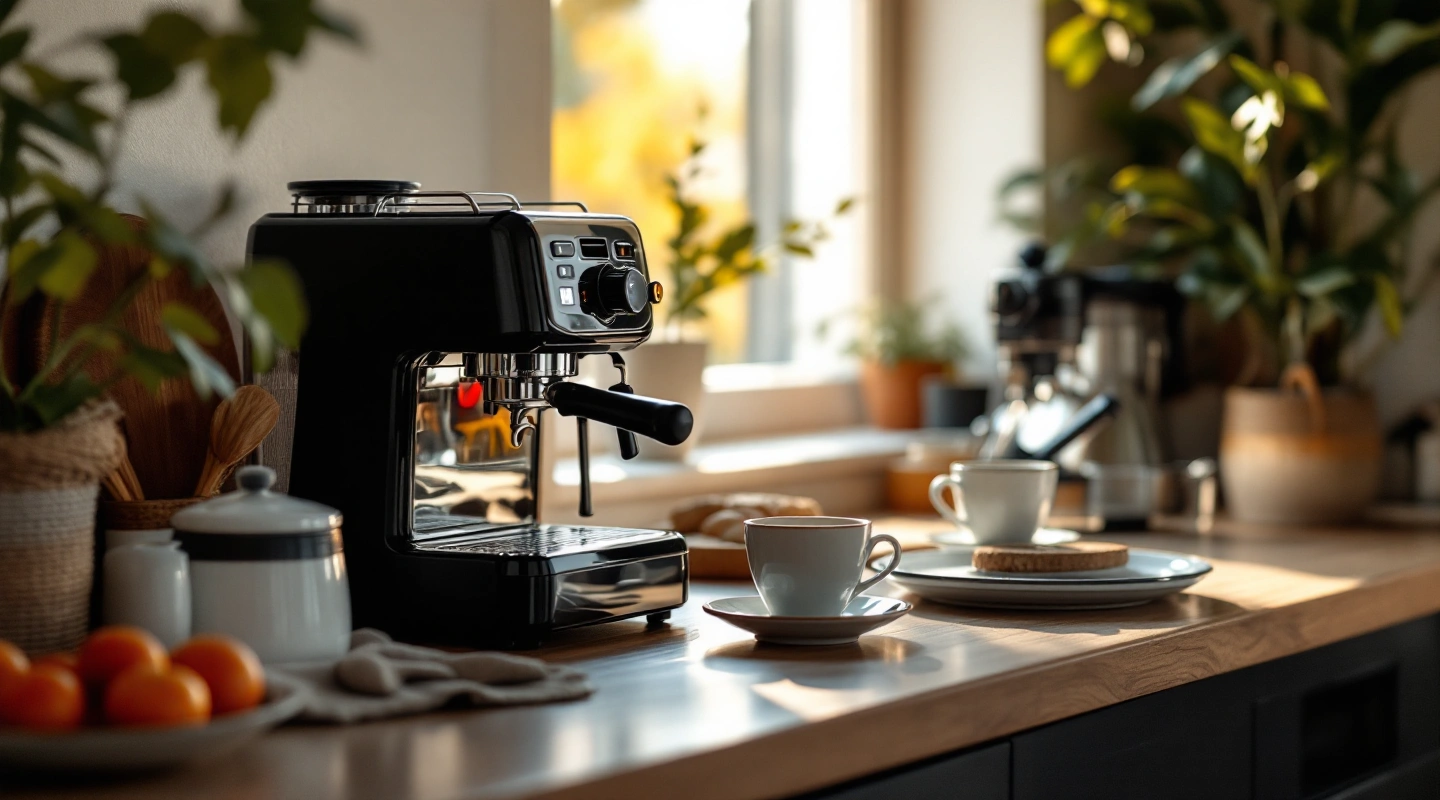
The main types of espresso machines differ in who prepares the coffee and controls the shot. A manual lever puts pressure control in your hands. A semi-automatic uses a pump while you prepare the basket. A fully automatic machine takes on more of the coffee preparation. Capsule systems use a different refill format.
Choose by the work you want to do each morning. Separate the brewing controls from the milk controls: an automatic shot stop does not imply automatic milk. Boiler and flow-heater labels describe heating, not the whole level of automation. Check coffee preparation and cleanup too. No machine type alone proves a taste result or a current price.
Types of espresso machines by user control
Assign each task to the user or the machine. Start with grinding and filling the brew path. Then check pressure control and shot ending. This task list cuts through names that shops use in different ways.
| Type | Coffee preparation | Shot control | Main check |
|---|---|---|---|
| Manual lever | Usually separate grinding and a filled basket | User action controls the lever; design varies | Heat method and pressure process |
| Semi-automatic pump | User prepares a portafilter | Pump starts on command; stop may be manual | Dose, grind and shot-stop controls |
| Volumetric pump | User may still prepare a portafilter | Programmed volume can stop the shot | Whether the basket work stays manual |
| Fully automatic bean-to-cup | Machine grinds and doses internally | Machine runs the chosen cycle | Brew-unit and milk cleaning |
| Capsule | User inserts a compatible capsule | Programmed cycle or user stop | Exact capsule format and running cost |
Scroll for more →
The boundary between semi-automatic and automatic is not always tidy. A portafilter machine can stop a shot for you but leave grinding, dosing and tamping to you. Read the task list, not just the category label.
The Breville BES450 US manual, Functions, is a useful example of user basket preparation with programmed shot buttons. The Gaggia Classic Pro US manual shows a pump machine with brew and steam controls. These sources were checked 15 October 2026. They document workflow examples, not a ranked product verdict.
Types of espresso machines by heating system
A boiler holds heated water. A thermoblock or other flow heater heats water as it passes through a path. Makers use specific names for their systems. Do not assume two units with similar labels have the same warm-up or recovery time.
A single-boiler machine commonly changes temperature between brewing and steam. Check its exact sequence and whether the manual calls for cooling or refilling before the next brew. The label alone gives no timed recovery result.
A dual-boiler design separates the two heating jobs. A heat-exchanger design uses a different arrangement. Both labels need a model-level check before you claim simultaneous brewing and steaming. Do not infer that feature from a large case or several switches.
A flow heater may reach its ready state quickly. That does not tell you how warm the portafilter or cup is. Separate the maker's stated heat-up claim from the whole drink workflow. Grinding, filling a basket and cleaning milk parts still take time.
Manual levers reward a different kind of attention
A manual lever can appeal to a person who wants to take part in the pressure process. The design might use direct hand force or a spring. Some models need an outside source of hot water. Others have their own heater.
Check which of those designs you are looking at before you plan a counter setup. If you need a kettle, include it in the required equipment. If milk drinks are the goal, check how you will steam or froth the milk. A lever does not imply a steam wand.
A simple mechanism is not proof of easy use. The operator may need to manage more variables. Nor does a small case prove that the full kit takes little space. Count the grinder and heat source. Allow working space for weighing coffee and drying parts too.
Semi-automatic pump machines keep the basket work
With a typical portafilter pump machine, you grind or measure the coffee, prepare the basket and lock the handle. The pump supplies water pressure. Depending on the model, you may stop the shot yourself or use a saved volume.
That division suits a person who wants to alter recipes. It also creates work. You must keep grounds off the rim, empty the basket and manage the grinder. A built-in grinder can reduce the number of separate boxes without removing these steps.
Check the included baskets. A pressurized basket can serve a different coffee supply from an open single-wall basket. “Beginner machine” does not tell you which one is supplied. The first-use workflow explains how to start with the basket you own.
Fully automatic does not mean no cleaning
A bean-to-cup system moves grinding and dosing inside the case. Drink settings can vary the amount of water or coffee used, within the machine's limits. The user still fills beans and water and empties waste.
Read the manual's brew-unit care instructions. Some systems have a user-removable unit; others use a different service and cleaning process. Do not assume every machine in the category permits the same rinse method.
Milk systems add contact parts. Read the care steps for every part that milk touches. The presence of an automatic rinse does not prove that every milk path is clean. Check the full procedure and the supplies it requires before choosing convenience on the button panel alone.
Capsules simplify one task and set another limit
A capsule provides a pre-portioned coffee format. You do not set the grind for that capsule in the way you would with whole beans. That can make the daily routine more predictable, but it narrows the coffee format you can use.
Confirm the exact system. A capsule made for one range need not fit another range from the same brand. Reusable capsules, where offered, need their own compatibility check. Do not treat a shared brand name as a universal fit promise.
For a running-cost comparison, use your own drink count and the actual refill cost. State whether the count means one capsule per drink. A large drink might use a different recipe. Keep waste handling and available local recycling routes in the decision as well.
Milk controls form a separate axis
A manual wand asks you to control the jug and texture. An automatic wand can use a sensor and saved settings. Other systems take milk through a carafe or hose into a separate path. These are different tasks even when a shop calls all of them a frother.
Decide whether you want to pour milk from a jug. For latte art, the texture and the pour both matter. A device that makes stiff foam may suit another drink well without giving the texture you want to pour.
Write down the cleaning steps beside the milk feature. A feature saves less work if its end-of-session routine does not suit you. The latte art guide covers the pouring workflow rather than ranking machines by a foam label.
Build a task list before comparing prices
Write down the drinks you make, how many in a row, and who will use the machine. Then list the steps you want to control. That is a clearer brief than asking for the most automatic machine within a ceiling.
In a household where one person drinks espresso and another makes milk drinks, the coffee cycle may be easy for both. The milk routine may differ. Check whether each user must adjust settings or whether the machine keeps a suitable preset.
For back-to-back drinks, read the maker's sequence rather than guessing from pump pressure. A nominal maximum pump figure does not state recovery time. Tank capacity does not tell you how much water each rinse uses. Leave those unknowns visible until the exact source resolves them.
Separate the machine-only price from the full kit. A required grinder belongs in the setup total. Optional handles and display accessories do not. Use the budget guide to allow for the tools your chosen routine needs.
Check hot water for long drinks
A hot-water outlet is another separate feature to check. A steam wand does not prove the machine has a dedicated water outlet. Read how the exact model dispenses water and which control selects it. For a longer drink, decide whether you will add hot water to espresso or run more water through the coffee. Those are different recipes, even when the cup size is the same.
Frequently asked questions
Is an automatic shot button a fully automatic machine?
No. You may still need to grind, dose and tamp the coffee. Check the tasks around the button.
Does a boiler make better coffee than a flow heater?
The label alone cannot establish that. Compare the exact model's controls and documented process. Taste claims need evidence beyond the heater name.
Is a capsule drink the same as every espresso recipe?
No. Capsule systems use their own coffee format and drink controls. Compare the specific drink and serving size you want.
Which type needs the least space?
Measure the full working setup. Tank access, grinder space and room for milk work matter as well as case width.
Verdict
Compare types of espresso machines by the tasks they leave to you. Choose the coffee format first, then the shot and milk controls. Check the heating sequence, cleaning steps and full equipment list before deciding whether a machine fits your kitchen and budget.