
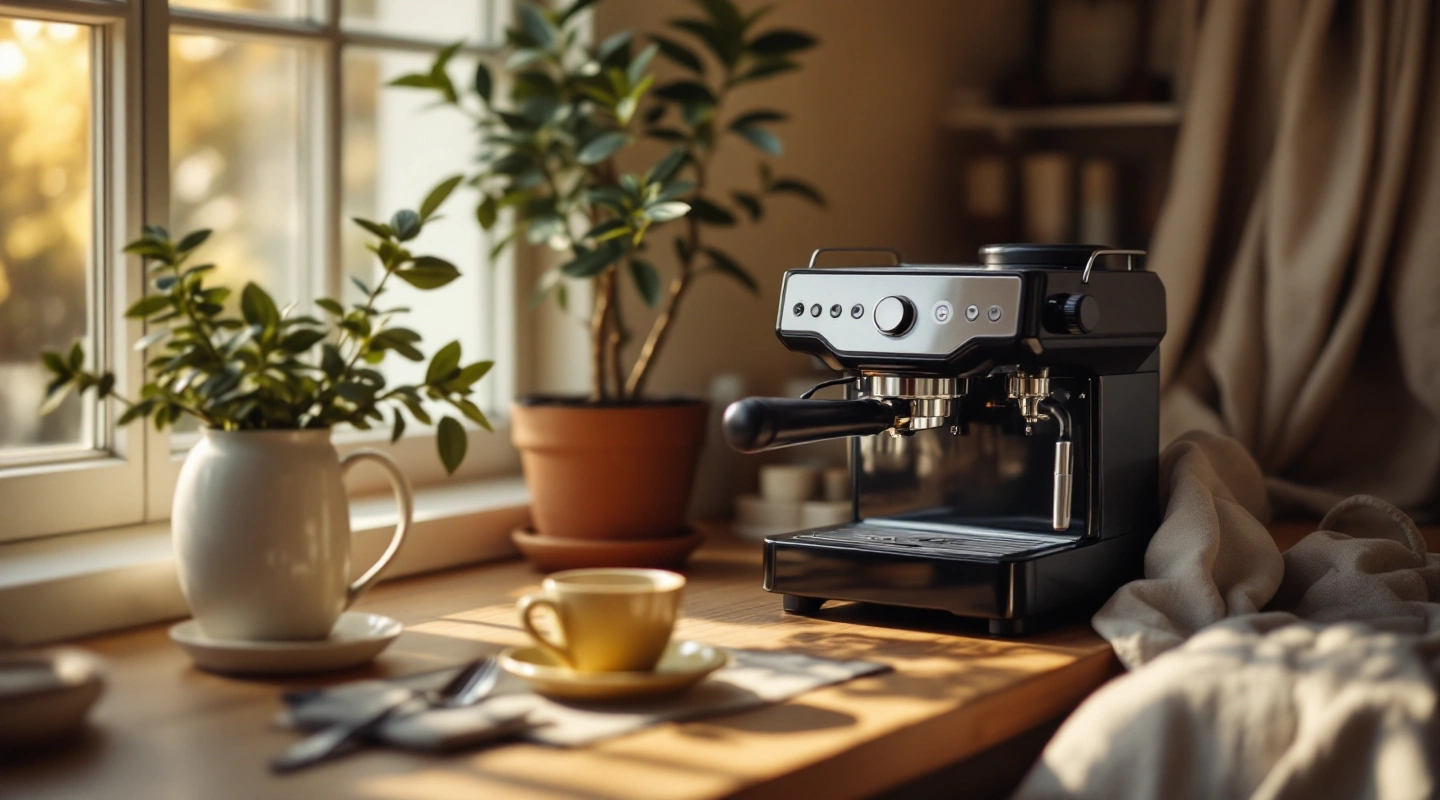
The Capresso EC100 espresso machine suits someone who wants to run the coffee and milk steps by hand. Model 116.04 uses a dial to start and stop delivery. Its supplied sieve system and removable milk sleeve shape that routine. Check model 116.04 when comparing an EC100 offer. A heater description does not establish the time needed to prepare coffee and finish a milk drink.
Choose the Capresso EC100 espresso machine if you want its manual dial process and supplied pressurized sieves. Check the exact kit and coffee route first. Compare another model if you need a programmed shot stop or automatic milk settings. A whole-bean setup still needs a suitable separate grinder.
Capresso EC100 espresso machine: a manual dial process
The EC100 model 116.04 uses a selector dial for coffee and steam. Its middle position is standby. The user returns the dial there to stop delivery. That makes it a machine to operate while watching the drink, rather than a drink menu to select and leave.
Decide whether that process suits the person who will use it. A manual stop can fit someone who wants to choose the amount in the cup each time. It is less suitable if the main aim is a programmed shot that ends without that action.
The green ready light has a role in the instructions. It does not weigh the coffee or tell you whether the grind suits the basket. Keep the coffee preparation and the heater state separate when learning the machine.
Capresso identifies a thermoblock heater. That description does not make the EC100 a single-boiler machine for comparison purposes. It also does not establish a complete-drink time. Allow time for coffee preparation as well as milk care when planning that first drink.
The sieve choice sets the coffee route
Capresso calls its coffee baskets sieves. Its product record identifies them as pressurized. That is worth knowing before choosing a grinder or a replacement handle. Do not assume the supplied system works like a traditional single-wall basket on another machine.
The manual describes one-cup and two-cup sieves. It also gives a pod route for the one-cup sieve. Check the exact pod specification in the instructions. The word pod alone does not establish compatibility with ESE paper pods or hard coffee capsules from another system.
For ground coffee, follow the EC100 preparation steps with the relevant sieve. The supplied measuring spoon has a tamping end. It provides a starting tool without requiring an immediate separate tamper purchase.
For whole beans, a grinder still belongs on the equipment list. The EC100 does not grind beans. Choose the grinder for the coffee route and useful adjustment controls. An unrelated coffee grinder is not proven suitable by the word fine on a dial.
Keep the initial coffee choice clear. If you switch from prepared grounds to whole beans or change the sieve, record that change. Keep the other recipe choices steady while you assess it. Changing the whole preparation at once makes the result hard to explain.
The frothing sleeve changes the milk task
The EC100 has a removable sleeve over its steam tube. Capresso distinguishes frothing with the sleeve from steaming without it. This is a parts-and-process choice. It is not the same as selecting a milk temperature on an automatic wand.
That distinction gives a buyer something concrete to compare. Do you want the sleeve's frothing route, or do you want to use the bare steam tube as the instructions describe? Read both before assuming that one setup serves every milk drink in the same way.
The user still fills and places the milk vessel. The user also controls steam delivery with the dial. There is no documented automatic jug placement or milk pouring task here. Treat the milk stage as work that needs attention.
Choose a milk vessel that leaves room for the instructed process. It needs space under the frother and a safe place to rest afterward. Do not infer working clearance from the machine's case dimensions alone.
Decide whether you want to make froth with the sleeve or use the uncovered steam tube for latte milk. That choice defines which arrangement to read about in the book. It does not remove jug handling or wand cleaning. Use the setup for your intended drink rather than assuming that every type of milk will behave the same way.
Cleaning the sleeve is part of every milk session
The manual gives a cleaning process for the removable sleeve and steam wand after use. Read that section before buying. A removable part can be easier to inspect, but it is still a part that must be cleaned and put back correctly.
Do not leave milk residue merely because steam continues to pass through the tube. A working steam path does not prove that the outside or sleeve is clean. Follow the cooling and cleaning precautions in the EC100 book.
The sleeve should also remain identifiable when removed. Keep it with the machine's parts rather than treating it as an optional piece of packing. The intended milk process depends on whether it is fitted.
This is a useful ownership distinction for a shared kitchen. Agree which parts should be cleaned and where they belong after a drink. A second user should not need to guess whether the frothing arrangement is complete.
Understand what happens to the water after brewing
The EC100 manual describes water from the heating system reaching the tray after a coffee cycle. That makes the tray part of the normal operating routine. Do not plan its capacity only around the small drips you expect under the cup.
Leave room to remove and carry the tray safely. A narrow counter can still be awkward if cups or a grinder block that path. Keep hot equipment out of the route to the sink.
The removable tank also needs access. Check that you can reach its lid and remove it in the intended position. A machine fitting beneath a cupboard does not prove that the refill motion will fit there.
Read the first-use rinse and prewarming instructions too. Those are separate from the act of making a shot. The maker's heater description does not mean that the cup and handle have already gone through the preparation you need.
Keep pressure and taste claims separate
Capresso lists a pump-pressure specification. A pump maximum is not a measured pressure at the coffee bed in every use. It does not tell you what a drink will taste like or how well a user's coffee preparation matches the supplied sieve.
A visible layer of foam is also not a taste test. The pressurized sieve has a role in the brewing system. Do not use the appearance alone to conclude that the grind and recipe are ideal for every coffee.
Keep the heater type and controls ahead of broad taste promises. They tell you which steps you can control and which sequence to learn. A feature list does not establish the flavour of coffee prepared in your kitchen. Match the sieve to the coffee you will use, then learn the preparation that the book describes.
If a particular result matters to your purchase, identify how it was measured and on which exact model. A maker's control diagram supports a control claim. It does not stand in for a measured cup result or a wear test for the offered unit.
Capresso EC100 espresso machine: account for the full kit
Begin with the exact offer's included components. Check the brewing parts against the list in the offer. The combined measuring tool also needs to be accounted for. A general product photo may show a milk vessel or cups that are not part of the retail kit. Resolve the list before assuming those items arrive in the box.
Then add what your chosen coffee route needs. Whole beans require a grinder. Milk drinks need a suitable vessel and space to use it. An optional replacement tamper belongs on another list until you know what job it needs to improve.
The machine's qualifying offer does not establish that every required extra fits the complete setup budget. A missing cost cannot be treated as zero. Keep the equipment list open until all required parts are accounted for.
This matters even if you own another coffee machine. Its parts may use a different interface. A handle with a similar appearance or a basket with a familiar diameter is not an exact EC100 compatibility check.
Do not turn a pressurized machine into an imagined upgrade path
Choose the EC100 for its documented stock process. A plan to change the basket, drill a part or modify the handle describes a different machine state. It is not a feature of the offered kit.
If you specifically want a traditional single-wall system, compare a machine documented for that route. Do not assume the EC100's supplied sieves provide it. A retailer's use of professional or barista language does not settle the basket design.
Likewise, if you want automatic milk settings, compare that control directly. The EC100's sleeve can change the milk process without providing the same automation. A broad frother label should not hide that distinction.
A good reason to reject a model can be just as useful as a reason to buy it. If the dial stop, sieve route or milk cleanup does not fit your needs, choose another process. That does not require an unsupported claim that this machine makes worse coffee.
Check the US identity before comparing the case
The model 116 book lists 120 V and 60 Hz. That is the US electrical reference used here. Match the offered machine's label and intended market before applying it. The EC100 name on a box from another market would not settle that check.
The same specification page gives the case as 10¼ inches deep, 8¼ inches wide and 11¾ inches high. Keep those labels beside the figures when measuring a counter. These are the maker's dimensions. Leave room to take the tank out and move the tray, then check the jug's path to the steam tube.
Use a piece of paper to mark out that footprint on the intended surface. Find places for the grinder and milk vessel, leaving room for a cup under the spouts. Work through the moves with the equipment cold. This can reveal an awkward corner before you have hot water and coffee on the counter.
The label check and the space check answer different questions. A correctly identified US model can still be a poor fit beneath a low cupboard. A clear counter does not establish that an imported electrical version suits the home.
Choose a coffee routine you can repeat
For a shared kitchen, agree which sieve and coffee format will be used first. Keep a simple note of the coffee and preparation. That gives a second user a clear starting point. It is more useful than a general promise that the controls are easy.
If you already own a grinder, check its adjustment range and how you will transfer grounds to the sieve. Allow space for spills and for the handle to rest securely. The whole task includes preparation away from the machine's front panel.
You may prefer a model with preset coffee buttons if stopping the flow by hand is the step you want to remove. That feature still leaves other work for the user. Compare the actual actions saved before choosing a different name or a longer feature list.
Frequently asked questions
Does the EC100 stop a coffee shot automatically?
The instructions tell the user to stop delivery with the selector dial. The middle position is standby. Do not expect the EC100 to end a shot at a programmed amount while you attend to another task. A ready light describes a heater state. It does not choose the dose or the amount you want in the cup.
Is the EC100 a single-boiler machine?
Capresso identifies a thermoblock heater in the model 116 specifications. Keep that design distinct from a single boiler when comparing machines. The heater description does not establish a measured drink time or a taste result. The full routine still includes preparing the coffee, handling the cup and, for a milk drink, using and cleaning the milk device.
Can the Capresso EC100 use espresso pods?
No. The manual gives a particular pod size for the one-cup sieve. Do not read the general word pod as approval for every ESE paper pod or a hard capsule system. Match the coffee product to the exact instructions before buying it. A coffee package saying espresso does not by itself establish that its format fits this machine.
What changes when I remove the frothing sleeve?
The book distinguishes frothing with the sleeve from steaming without it for latte milk. This changes the supported milk process. It does not add automatic milk heat or texture settings. Read the instructions for the arrangement you choose and follow the hot-part precautions. Keep that distinction in mind when choosing between froth and heated milk for pouring.
Why does the tray need emptying after coffee use?
The book describes remaining water from the heating system reaching the tray after coffee delivery stops. The tray therefore collects more than the drips from a cup. Keep access clear and follow the emptying instructions. This described behaviour is not a diagnosis for every leak; unexplained water elsewhere needs the model's troubleshooting or service advice.
Does the EC100 include everything for a whole-bean milk setup?
Do not assume so. Check the exact offer's contents, including the brewing parts and scoop with its tamping end. Whole beans need a suitable grinder because there is none built into the EC100. Check the milk vessel too. A missing required item stays on the equipment list rather than being treated as included or free.
Verdict
Choose the Capresso EC100 espresso machine if you want its manual dial process and supplied pressurized sieves. Check the exact kit and coffee route first. Compare another model if you need a programmed shot stop or automatic milk settings. A whole-bean setup still needs a suitable separate grinder.