
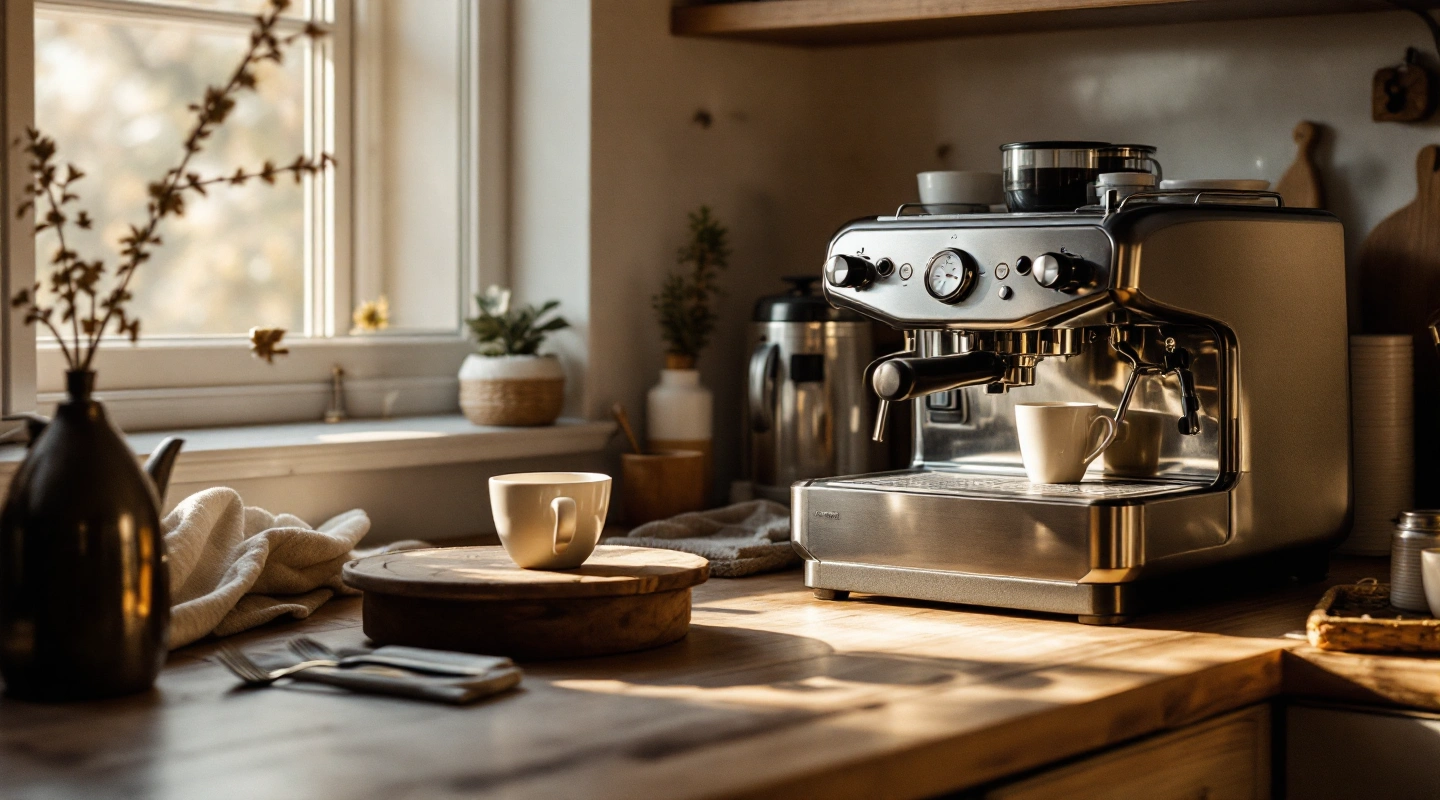
Choose the DeLonghi Dedica Maestro Plus EC950M if you want help with milk while preparing the coffee yourself. Its automatic milk settings serve a different task from its coffee heat control. It also has a manual steam option. Match the basket to your starting coffee. Include a suitable separate grinder if you plan to use whole beans.
The DeLonghi Dedica Maestro Plus suits a buyer who wants automatic milk settings and still wants to prepare coffee by hand. Check the exact US kit and your grinder needs. Use the manual mode only as its own instructions describe. Compare another route if you want the machine to grind beans and finish a named drink for you.
DeLonghi Dedica Maestro Plus: separate the three choices
The EC950M lets you choose a coffee heat setting. It also has separate controls for milk heat and texture. These choices serve different tasks. A coffee setting does not choose the milk heat. None of those controls fills the basket for you.
The US manual makes that division visible. You still put the coffee in the right filter, tamp it and fit the handle. The automatic milk cycle takes on part of another stage. It is a useful form of help when milk work is the task you want to hand over.
This is not a machine that grinds beans and prepares a named milk drink from one selection. A whole-bean setup needs a separate grinder. Keep that requirement clear beside the milk features rather than assuming the word automatic applies to the whole drink.
This split can suit you if you want to learn to prepare coffee but need help with milk. For a bean-to-cup drink, look at that machine type instead. Choose the Maestro Plus for the tasks it takes on.
A, M and OFF have different jobs
For automatic steaming, use position A in DeLonghi's book. For manual steam, use M. The wand position helps select the process. A milk setting alone does not make every wand position suitable.
The automatic route uses the selected milk heat and texture. Prepare and place the jug as the book directs, then use the steam control. The jug still needs the correct starting milk level and room for the milk to expand.
The manual route gives the user the jug and wand work. The book says that milk froth and temperature settings cannot be selected for this function. Do not expect the automatic settings to control the manual cycle in the same way.
The OFF position also has a care role after milk use. DeLonghi directs users to put the wand there for automatic rinsing. Treat the position change as part of finishing the drink, not merely a choice about how to store the wand.
Read the diagrams for the exact movements before use. These letters describe the maker's controls; they are not a substitute for its complete operating and hot-surface instructions. Keep the tray in place and remain clear of the rinse discharge.
Manual steaming still has its own stopping task
The supported manual option can matter if you want to practise jug control. You decide how to use the wand with the milk and when to finish the process. The control choice does not by itself establish a better foam result.
The book explains what the milk heat light shows during this route. The light gives you information. It does not turn the manual process into the automatic cycle. Follow the instructions to stop steam and wait before removing the jug.
That distinction can be useful in a shared household. One user may choose automatic help while another wants to practise by hand. They still need to leave the wand and tray ready for the next person. A choice of modes does not remove the shared cleanup work.
Decide which mode you want to use for the milk drinks you make often. Automatic settings can address a task you want help with, while manual mode leaves the jug work with you. Keep those roles clear for everyone sharing the machine. The mode choice does not remove coffee preparation or the care required after milk use.
DeLonghi Dedica Maestro Plus: match the basket to the coffee
The US book lists single-wall and double-wall baskets. It relates the single-wall route to a grinder with fine espresso adjustment and the double-wall route to suitable pre-ground coffee. Choose the route before treating the equipment list as complete.
With whole beans, the separate grinder is part of the setup. A grinder's ability to make fine coffee is not the whole question. You also need useful steps for changing the recipe. Milk settings do not compensate for a missing or unsuitable coffee grinder.
The double-wall option offers another starting process. Follow the maker's preparation guidance and check that the offered kit includes the parts for it. Do not assume that every retail bundle contains everything shown in a general product photograph.
Changing basket type can change the grind and dose needed. Record the change instead of keeping every old choice by habit. A shared handle does not mean two baskets ask for the same preparation.
If you are unsure which route you want, list the coffee you intend to buy and the grinder you already own. That gives the choice a concrete starting point. It is more useful than buying an extra basket because its title sounds professional.
Choose an infusion setting for your coffee route
The machine offers three infusion-temperature levels. They give the user a documented coffee setting to change. The setting alone does not establish the flavour from every bean and recipe.
Begin with the maker's suggested process. If you change the temperature, keep the other recipe choices steady while assessing the result. Changing several things at once makes it hard to know which one mattered.
The shot buttons also do not weigh the dry dose or drink output. A preset delivery quantity is part of the control system, not a check that every basket preparation is the same. Use a scale if weighing is part of your chosen recipe and the equipment fits safely.
Do not borrow an Encore grinder setting or a basket dose from another model as though it were a machine feature. Recipe guidance should remain tied to the coffee and equipment in use. Keep a note of the basket and your preparation when making a change, so you can tell which choice you want to keep.
The first-use process includes the milk path
The US manual has a rinse procedure for the new machine. It covers the coffee path and an automatic steam operation with cold water in the jug. Read that setup before starting ordinary drink preparation.
The ready state after heating is not a replacement for the initial rinse. These instructions serve different stages of ownership. A machine taken from the box has preparation tasks that a machine already set up for daily use does not.
Give the tank a clear refill route. Its removal and replacement need access above the case. A machine fitting below a cupboard is not enough to establish that you can lift the tank there comfortably.
The jug needs a route too. You must place it under the wand, move it away safely and finish the rinse process. Leave room for that work in addition to the machine's footprint and any separate grinder.
Only some removable parts are dishwasher-safe
The US book identifies the drip tray, milk jug and small cup tray as dishwasher-safe. That is a limited parts list. It does not mean every removable part or metal-looking piece can go in the dishwasher.
Follow the separate filter and handle instructions. A broad catalog phrase such as easy-to-clean parts should not overrule those details. Correct care depends on which item you are washing.
After milk use, wipe the residue as instructed and return the wand to OFF for rinsing. An automatic rinse does not prove that the outside of the wand is clean. Both actions belong to the care routine.
The water-hardness setting also has a purpose in the manual's descaling reminders. Follow the test and setting instructions for your water. Do not assume that a general filter label removes the need for descaling or establishes fit in this tank.
Choose the feature you will actually use
The strongest reason to choose the Maestro Plus is a need for its milk controls while keeping user coffee preparation. The supported manual option can also matter if people in the household prefer different ways to steam.
Someone making only straight espresso should judge the coffee controls and required kit first. Automatic milk settings do not enter that drink. A longer feature list does not establish a benefit for a task you do not perform.
Someone wanting a whole-bean setup must still account for the grinder. Check the exact offered kit and all required extras. A qualifying machine offer does not prove that the complete setup meets the same budget.
Keep optional tools apart from those requirements. Start with the supplied parts where they support your route. Add a replacement only for a clear fit or workflow need, not because it appears in another person's kitchen photo.
Check the stock US kit before adding upgrades
The US book's parts list includes the portafilter and coffee baskets, with single-wall and double-wall choices for one or two cups. It also lists a tamper and milk jug. The scoop and cleaning tools have their own places in the kit. Check the exact offer's packing list against those items before buying spares.
The book identifies the US electrical version as 120 V, 60 Hz. Match the offered machine's model and electrical label to the version you need. The EC950 family name by itself does not prove that a unit from another market has the same supply requirements.
For a new kitchen setup, begin with the parts required to make the chosen drink. A whole-bean route adds a grinder. A pre-ground route has different coffee preparation needs. A second handle or a distribution tool is a separate choice and should solve a clear problem before joining the starting list.
Do not count a supplied tamper as proof that any replacement will fit. A replacement tool needs the right working diameter and shape for the chosen basket. A basket that fits inside a handle also needs enough depth and clearance. Check the complete combination.
Plan the moves for a second milk drink
Think through the return from the first drink before planning a row of cups. The handle needs to be emptied and prepared again. The milk jug needs its next fill, and the wand has its own finishing routine. Automatic milk settings do not perform those jobs between drinks.
If two people will use the machine, agree which parts belong on the tray and where the cleaned jug goes. Keep the instructions accessible for anyone changing modes. The labels A and M are useful only when the user understands the different process each one selects.
Compare the Bambino Plus if you want another machine with automatic milk settings. Read its basket directions and care steps too. A shared feature name does not mean that both controls or both retail kits work in the same way.
Frequently asked questions
Does the Maestro Plus grind coffee beans?
No grinder is built into the documented EC950M. A whole-bean route needs a suitable separate grinder. The automatic milk controls do not change that requirement. Choose the basket and coffee format first, then list the equipment needed for that route. A picture of a grinder beside the machine is not proof that one is included in the offer.
Can I use the wand manually as well as automatically?
Yes. The US book describes position A for automatic steam and M for the manual route. Follow the diagrams for the chosen mode. Milk heat and texture settings cannot be selected for the manual function as they can for the automatic one. Choosing manual steam therefore changes the user's role, not just the position in which the wand is stored.
Are coffee heat and milk heat controlled by the same setting?
No. The manual identifies an infusion-temperature control and separate milk settings. Keep those controls distinct when comparing features. A change to the coffee setting is not a change to the milk setting. Neither one prepares the grounds or weighs the drink. Follow the directions for the coffee route and milk mode you actually select.
Can all removable parts go in the dishwasher?
Do not assume so. The US book names the drip tray, milk jug and small cup tray as dishwasher-safe. Follow the separate care directions for the handle, filters and other pieces. A limited list is not approval for everything that comes off the machine. The finish or material of a part alone does not decide its care method.
Does the automatic wand rinse remove all milk cleanup?
No. The manual also directs the user to wipe milk residue and return the wand to OFF for rinsing. Those actions serve different parts of the care task. Keep the discharge area clear and follow the exact sequence. A rinse through the steam path does not establish that the outside of the wand has been wiped clean.
Is DeLonghi Dedica maestro good?
The Maestro Plus EC950M is a useful fit when you want automatic milk settings while preparing the coffee yourself. Its documented routine still asks you to fill a filter, tamp the grounds and lock in the handle. Automatic milk work helps with a later stage. Compare a bean-to-cup design separately if removing grounds preparation is your main reason to replace a machine.
Verdict
The DeLonghi Dedica Maestro Plus suits a buyer who wants automatic milk settings and still wants to prepare coffee by hand. Check the exact US kit and your grinder needs. Use the manual mode only as its own instructions describe. Compare another route if you want the machine to grind beans and finish a named drink for you.