

The Gaggia Classic Pro name needs a version check before a buying decision. The brushed-steel Classic E24 RI9380/46 suits someone who wants its manual brew and steam routine. It does not offer automatic milk settings or an integrated grinder. Keep the exact version beside the supplied kit when comparing offers. Whole beans still need a suitable separate grinder.
Choose the E24 in this Gaggia Classic Pro guide for manual brew and steam work. Verify the exact version and basket route. It has no automatic milk settings or built-in grinder. A machine-only offer does not confirm the full whole-bean setup.
Gaggia Classic E24 RI9380/46
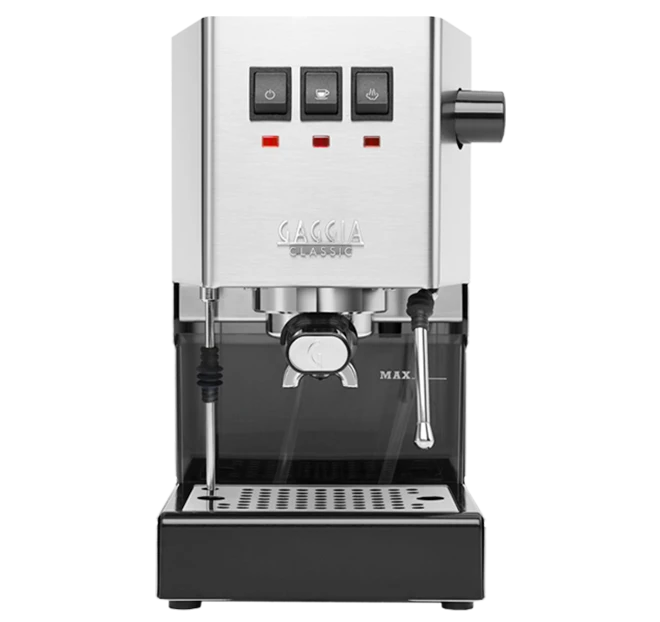
Gaggia Classic E24 RI9380/46 Gaggia Classic E24 RI9380/46
Our verdict:
Model reference: outside budget
Outside this budget: the US maker lists the E24 from $549. It is not an under-$500 recommendation.
Keep in mind: Steam-to-coffee work includes a cooling sequence. It has no automatic milk settings or integrated grinder.
Outside this budget: the US maker lists the E24 from $549. It is not an under-$500 recommendation.
View at GaggiaGaggia Classic Pro: identify which version the offer describes
Gaggia Classic Pro is a name used for several versions. A shared case shape or colour does not tell you which one will arrive. Read the full model code. Check the parts in the exact offer before you compare features.
The US Classic Pro manual names RI9380. Gaggia's current E24 has its own US and Canada manual. Match the brushed-steel E24 offer to its E24 manual. Do not transfer its boiler claim to an offer named only Classic Evo Pro.
This is a practical buying limit. If the offer does not resolve the version you want, ask the seller for the exact identification. A photograph of a front panel cannot settle the internal specification. A product title that uses several family names does not make them interchangeable.
Choose from the facts for the exact model on offer. Not all stock has the same boiler or kit. An older version can remain on sale. That does not make it the newest model.
Why the manual operating process matters
The Classic's controls leave much of the work to you. You prepare the basket and start the brew. You stop it when the intended output is reached. You also choose when to switch tasks and prepare milk.
That process can suit someone who wants to learn each brewing stage. It is a poor match for a one-button drink routine. The machine has no grinder and does not pour milk for you. Choosing to do the work by hand does not prove a better taste result.
If several people will use the machine, agree on a simple routine. Keep the chosen basket and recipe clear. Change one recipe choice at a time. That helps you work out what caused a new result.
The machine types guide explains the control categories. The label semi-automatic does not mean that every machine bearing it automates the same tasks. Read the actual brew and milk sequence for the model under consideration.
Basket choice changes the required grinder
The Classic Pro instructions distinguish the supplied filter arrangements. Use the basket and related parts exactly as directed for the coffee route you choose. Do not assume that a basket borrowed from another machine will behave like the original one.
For a traditional basket, the coffee bed and grind affect the water flow. A suitable espresso grinder belongs in a whole-bean setup. The machine does not contain one. A fine setting alone is not enough. You also need useful steps to adjust the recipe.
A pressurized basket has a different role. Follow the exact manual's coffee and parts guide for that route. Two baskets can fit inside the same handle. That does not mean they need the same grind or work in the same way.
Before ordering, list the grinder you already own and the coffee you plan to buy. If the grinder is unsuitable or absent, the full setup budget needs another item. Machine-only eligibility cannot confirm a machine-and-grinder total.
The portafilter is a system, not just a size
Gaggia lists a 58 mm filter-holder system for the Classic. This helps narrow a parts search. It does not mean every 58 mm handle will lock into the machine.
The locking tabs, rim, basket depth and group geometry still matter. A basket can fit into a handle while the handle fails the machine's locking interface. A deeper basket may also change the available clearance in the assembly.
Choose by exact model and part code. Keep the original part until you have checked the new one safely. Follow the maker's fit check. Do not force a tight handle. If it leaks, do not turn it beyond the instructed position.
Our Gaggia portafilter reference separates the family and version checks. It also explains why Classic names and nominal dimensions cannot verify every third-party part. Nominal fit alone does not show that a part will improve drink quality.
Milk steaming is work you control
The Classic Pro manual describes manual steaming. You prepare the jug, bring the machine to the required state and use the steam control. The wand's position in the milk and the user's movements remain part of the process.
That is different from an automatic wand with selectable milk temperature and texture. If reducing manual jug work is your goal, compare that specific task with the Bambino Plus. Do not choose a Classic expecting it to perform the same automatic milk cycle.
Allow room around the wand for the jug you will actually use. A jug needs space to move, then a safe resting place. Keep the tray in place. Follow the manual's hot-surface and discharge precautions throughout the steam process.
After steaming, use the specified cleaning procedure. Wipe and purge as directed and clean the relevant parts. A steam wand can still pass steam while carrying dried milk residue; visible steam alone is not a cleanliness check.
Plan how you will move from coffee to steam and back again. A maker's design facts explain the controls, but the user still has work between drinks. Include preparing the next basket and caring for the wand, as well as the cooling process in the book.
Read the brew-to-steam sequence before buying
The heating and control sequence should fit the drinks you make. Read how the exact manual moves from startup to brewing, then to milk work and the next coffee. A boiler label alone does not tell you the time between those tasks.
Someone making straight espresso has a different routine from someone alternating espresso and milk preparation. More drinks also mean repeating the preparation and care tasks. Those jobs remain even when the machine uses a familiar commercial-style handle.
Follow the ready indicator as part of the maker's full operating sequence. Keep cup preparation separate from that ready state. A light for the machine does not complete the work of filling the basket or handling the milk jug for your chosen drink.
If fast preparation is your main aim, compare the whole process rather than a heater headline. Include grinding, preparing the basket and milk work. The Gaggia versus Bambino comparison is framed around those tasks rather than a made-up speed ranking.
The E24 boiler does not change every task
Gaggia lists a brass boiler for the E24. That identifies a design feature for this version. It does not establish the taste of a finished drink or remove the user's steps. Read the brew and steam sequences alongside that feature before deciding that the stock routine suits you.
It also does not make the wand automatic. You still choose the brew and steam controls. You still prepare the coffee. A change to one internal part does not hand those jobs to the machine.
The US E24 manual has a step for lowering the boiler temperature after steam work. Read it as part of the drink sequence. Do not assume you can switch straight from steaming to brewing without following that step.
This is a useful distinction if you make mixed orders at home. One person may want milk while another wants straight espresso. Plan the order of tasks using the manual. Do not judge the whole routine from the boiler material alone.
Keep the supplied basket parts together
The US E24 manual pairs the Crema Perfetta filter with its frothing jet device. The traditional baskets use a different arrangement. Follow the diagrams for the basket you choose. Do not leave an insert in place merely because it was there when you opened the box.
Put unused basket parts in a safe place where you can identify them. A small insert can be easy to confuse with a spare part. Keeping the manual and parts together makes a later basket change easier to check.
Change the setup while the parts are cool, as the manual directs. Recheck the dose and grind when changing the basket. A basket that looks almost the same may ask for a different coffee setup.
If a basket or insert is missing from the offer, resolve that before using the related route. Do not improvise a substitute from another model. A familiar part name is not an exact compatibility check.
Buying a complete setup without double-counting
Begin with the exact offer's included kit. Account for the handle and the baskets you need. Check the preparation tools too. A general product photograph or an accessory shown beside the machine does not prove it is included in the offer you will receive.
List the parts required for your intended coffee route next. For whole beans, that normally means a suitable grinder. For milk drinks, check the jug and the space available to use it. Optional handles, distribution tools and other upgrades belong on another list.
Keep those lists separate. Buying every optional tool at the start can leave less room for a required item. Conversely, leaving a grinder off the list does not make a whole-bean setup complete. The equipment list should follow the drink process.
An unknown required cost stays unknown. A machine that meets the machine-only ceiling may still need a grinder or another essential for your route. Include each missing item in the complete setup plan. Check the shopping destination for the current configuration and final checkout terms.
Maintenance is part of ownership
Read the manual's care section while choosing the machine. It sets out the cleaning and descaling procedures for that model. A procedure for another Classic generation may mention different parts or supplies, so keep the version clear.
Cleaning coffee residue and removing scale serve different purposes. Use the products and steps the exact manual permits. Advice that a household acid or a generic cleaner works in another machine does not establish that it is approved here.
Removable parts still have washing instructions. Do not assume a metal-looking part is dishwasher-safe. Check each coffee and water part in the manual. The milk device also has care steps, with cooling and electrical precautions to follow.
A parts list is useful when you can match the right code. It does not establish how simple a repair will be or which part a particular fault needs. Keep the exact version and its service terms beside the list. Available spare parts alone do not establish the condition of the unit you are buying.
Be cautious with modification advice
Online Classic discussions often concern changes to controls or internal parts. A changed machine does not show how a stock one behaves. A test of a modified unit is not a test of this retail offer.
Choose the machine for its documented stock functions. If a desired control exists only after a modification, treat it as absent from the offered machine. A hoped-for future change is not a feature in the box.
Internal work also brings electrical, heat and pressure hazards. Follow the maker's service and safety instructions. Do not use forum enthusiasm as evidence that an internal task is safe for an untrained owner.
That boundary helps compare the Classic with other machines fairly. Compare stock with stock, the same market and the same generation. Avoid giving one option credit for an imagined upgrade while judging the other only by its supplied controls.
What would make another machine a better match?
Choose another route for automatic milk work, a built-in grinder or a drink menu. Buy the Classic because you want its manual process. Do not expect it to take over those other tasks.
The Bambino Plus comparison focuses on milk automation. The standard Bambino comparison addresses a compact machine with manual milk work. Both require exact version checks before a product enters the picks.
If you are still choosing the coffee route, read the semi-automatic selection guide first. That lets you compare equipment requirements before committing to a model family. A useful shortlist can rule out a machine for the right reason without claiming that it makes worse coffee.
Gaggia Classic Pro: check the offered version
Use the US E24 RI9380 instruction book for the brew and care sequence that comes with this version. Gaggia's E24 specification identifies the brass boiler and manual controls. Match that version to the offer before choosing a basket, setting aside space for a grinder or planning how to alternate coffee and milk drinks.
Match the offered version before using a feature in the purchase decision. A colour name or older review does not identify its boiler, included kit or generation. Check the full model specifications and the contents list together. If a feature still cannot be tied to that version, leave it out of the reasons to buy until the exact unit is confirmed.
Frequently asked questions
Does every Gaggia Classic Pro have the E24 brass boiler?
No. Gaggia assigns that design to the E24 version. The words Classic Pro or Classic Evo Pro alone do not establish the same internal parts. Check the offered model and version before comparing them. An older review of another generation is not proof of the current E24's specification, and a colour name does not settle the generation.
Does the E24 include an espresso grinder?
The stock machine does not have an integrated grinder. A whole-bean route therefore needs a suitable separate one. The basket choice affects the coffee preparation you need. Make that choice before treating the shopping list as complete. Do not add an unpriced required grinder to a machine-only offer and assume that the full setup still qualifies.
Is milk work automatic on the Classic E24?
No. The stock E24 uses a manual steam and jug process. You manage the milk stage and follow the instructions for returning from steam to coffee work. It does not provide the automatic milk heat and texture choices described for a Bambino Plus. A buyer who wants that help should compare the documented automatic-milk route instead.
Should the Crema Perfetta jet stay in every basket?
No. The E24 US manual pairs the frothing jet with the Crema Perfetta basket and excludes it from the traditional-basket route. Keep the matching parts together and follow the book for the selected route. Switching baskets can change the preparation requirements. Do not transfer a part from one route to another simply because both baskets fit the handle.
Can the E24 brew another coffee immediately after steaming?
The manual includes a process to lower the boiler temperature after steam use before brewing coffee again. Follow that process and its ready-state instructions. Include the required user actions when planning several drinks. A tank size or boiler-material claim does not replace the sequence or establish when every part of the order will be ready.
Will any nominal 58 mm portafilter fit the Classic?
Do not assume so. The nominal basket system does not establish every handle's locking geometry or clearance. Use an exact compatible compatibility listing and the offered machine version. A basket that fits inside a handle is only one part of that check. The handle still needs to fit the group correctly without being forced.
Are all cleaning supplies already in the stock kit?
Do not assume that every care item is supplied with the machine. The E24 manual's brew-group cleaning process uses cleaning tablets and a blind filter purchased separately. Check the exact retail kit and the maintenance instructions when planning required extras. A short first-use list does not account for all of the equipment needed over ownership.
Do modification guides prove what the stock E24 can do?
No. A changed machine does not establish the behaviour or features of the stock offer. Choose the machine for the functions documented for its exact version. A hoped-for future change is not an included control. Check whether the original brew and steam routine suits your needs before buying around a modification plan that still has unresolved parts or requirements.
Verdict
Choose the E24 in this Gaggia Classic Pro guide for manual brew and steam work. Verify the exact version and basket route. It has no automatic milk settings or built-in grinder. A machine-only offer does not confirm the full whole-bean setup.